
Membership Dues Meaning, Explained Without the Jargon


What membership dues mean for your club
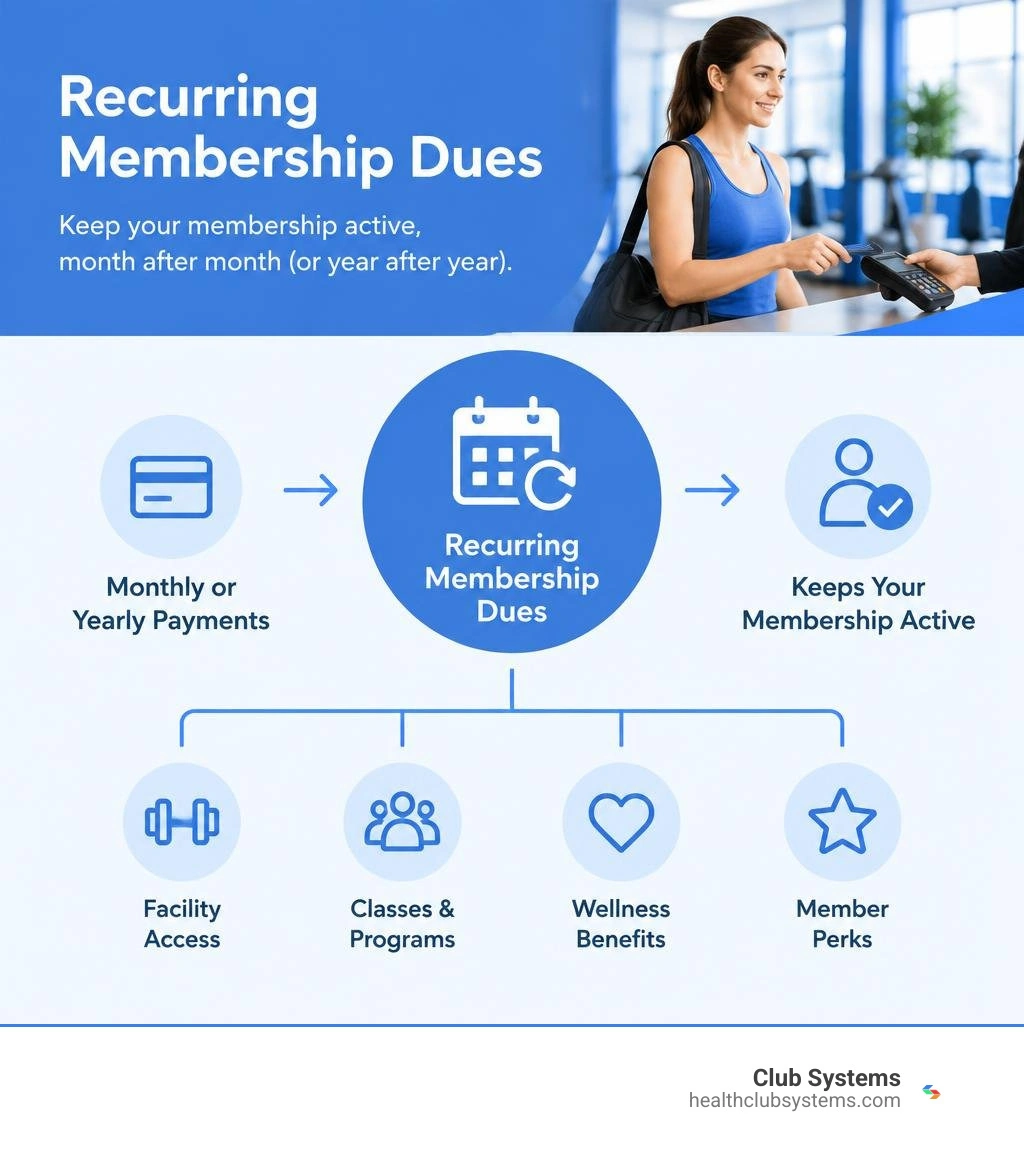
Membership dues are the payments people make to keep their membership active. They are often charged monthly or yearly. At a gym, dues typically pay for ongoing access to the facility and the benefits included in a member's plan.
Dues are different from a one-time joining fee. They are also different from a donation, which is a voluntary gift. Knowing what each charge covers helps members understand their bills and helps owners set clear payment terms.
I'm Eric A. Speer, owner and CEO of Club Systems. After nearly three decades working with gym software and billing, I’ve found that explaining membership dues meaning starts with one simple question: what does the member get for the payment?
Membership dues meaning terms to know:
Membership dues meaning: a plain-language definition
At its core, the word "dues" refers to regular, required payments made by an individual or business to maintain good standing in a group. According to the Cambridge Dictionary definition of dues, they are the official payments you make to an organization you belong to.
Unlike a one-time product purchase, dues represent an ongoing exchange: members provide regular financial support, and the organization delivers continuous services, access, advocacy, or facility upkeep in return.
Whether it is a labor union collecting dues via payroll deductions to fund collective bargaining, a local chamber of commerce supporting regional business growth, or an athletic facility providing workout access, dues form the operational lifeblood of member-based organizations.
Membership dues meaning in a gym or club
In fitness centers, health clubs, and sports clubs, dues represent the recurring subscription fee members pay for ongoing rights to use facilities, equipment, locker rooms, and programming.
Depending on your facility's operational structure, dues may be billed every month, every quarter, or once a year. Understanding how recurring dues differ from an upfront annual fee or baseline membership fees helps fitness operators create clear contracts that prevent confusion at the front desk.
Membership dues meaning in nonprofit and association settings
For trade associations, professional societies, and nonprofits, dues represent primary operating revenue. The Cambridge Dictionary definition of membership highlights the state of belonging to an organized collective.
In these environments, annual dues—such as $200 for a state CPA society or $1,000 for a specialized medical association—fund essential member perks. These perks include industry journals, continuing education credits, legislative lobbying, networking mixers, and entry into annual conferences.
Dues vs. donations, one-time fees, and initiation fees
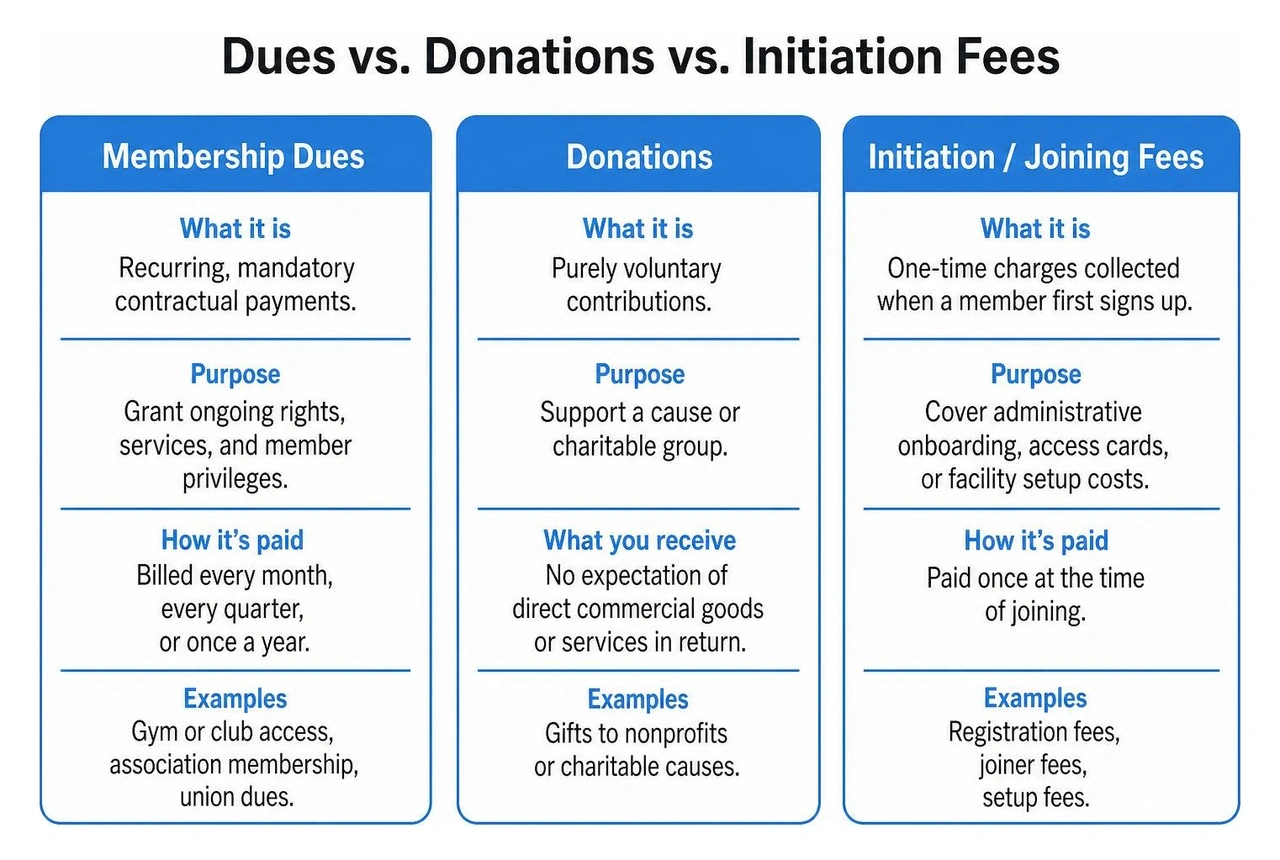
It is easy for consumers and new operators to mix up membership terminology, but the differences carry significant legal, tax, and operational implications:
- Membership Dues: Recurring, mandatory contractual payments that grant ongoing rights, services, and member privileges.
- Donations: Purely voluntary contributions given to a cause or charitable group without the expectation of direct commercial goods or services in return.
- Initiation / Joining Fees: One-time charges collected when a member first signs up, typically covering administrative onboarding, access cards, or facility setup costs.
Membership dues models, tiers, and pricing decisions
Choosing the right cadence and structure for dues shapes your cash flow, administrative overhead, and member retention.

Monthly, annual, and multi-year dues: pros and cons
Different payment frequencies serve different operational needs. Exploring the different types of gym pricing models allows organizations to balance upfront liquidity with long-term retention:
- Monthly Dues: Members pay a recurring amount (for example, $20 to $100 per month). This model lowers the financial barrier to entry, encourages steady year-round cash flow, and allows operators to analyze active subscriber counts in real time. However, it requires active billing management to handle expired cards and recurring bank drafts.
- Annual Dues: A single upfront payment (such as $50 for a community club or $600 for a fitness center) covering a full 12-month period. This provides immediate working capital and reduces monthly transaction processing overhead, but can suffer from high drop-off rates at renewal if members develop a "pay-and-forget" mentality.
- Multi-Year Dues: Members commit to 3 to 5 years upfront, usually in exchange for a discounted annual rate. This secures guaranteed long-term revenue and deep member commitment, though it is generally attractive only to the most dedicated core members.
| Dues Model | Cash Flow Impact | Administrative Overhead | Member Retention Dynamic |
|---|---|---|---|
| Monthly Dues | Steady, predictable monthly income | Requires automated recurring billing and card updates | Low barrier to join; ongoing engagement needed |
| Annual Dues | Large upfront cash injection | Low ongoing transaction frequency | Requires proactive renewal reminders to prevent drop-off |
| Multi-Year Dues | Significant immediate capital | Minimal ongoing management | Locks in member commitment for extended periods |
Flat-rate dues and membership tiers
Organizations generally implement one of two billing philosophies:
- Flat-Rate Dues: Every member pays the same rate and receives identical access. This works well for boutique studios, small community clubs, or organizations where everyone utilizes the same basic set of services.
- Tiered Membership Models: Pricing varies based on member demographics, access levels, or usage frequency. For instance, an association might offer discounted rates for university students and young professionals to build a long-term pipeline, while establishing premium corporate tiers for established enterprises. Health clubs often offer basic gym-floor access on an entry tier and add unlimited group fitness or 24/7 access on higher tiers.
How to choose a dues model and set a fair amount
To establish a sustainable dues rate, evaluate your organization's total monthly operating expenses, debt service, facility overhead, and required profit margin against your projected member count.
Survey your existing members to understand what programming they value most, research comparable organizations in your geographic or professional niche, and craft customized membership plans that increase retention by giving members options that match their exact budgets and schedules.
Collecting dues and increasing them without losing members
A solid pricing strategy only works if your collection mechanisms run smoothly and your communication remains transparent.

Best practices for collecting membership dues
Minimizing friction in the billing process is essential for maintaining strong revenue and high retention rates:
- Embrace Recurring Digital Payments: Transitioning away from paper invoices and manual checks reduces payment delays. Implementing automated dues processing alongside dependable recurring EFT allows accounts to draft reliably on set billing dates.
- Use Multi-Stage Renewal Calendars: Send personalized renewal notices well ahead of due dates—one week prior for monthly debits, 60 to 90 days prior for annual plans, and 6 months out for multi-year renewals.
- Provide a Reasonable Grace Period: Give members a brief window (typically 5 to 10 business days) to resolve billing issues before canceling account privileges.
- Deploy Professional Recovery Systems: When cards expire or bank accounts change, having dedicated collections and automated account updaters protects your facility from involuntary churn without damaging customer relationships.
How to raise dues while protecting member retention
Inflation, rising commercial lease costs, and investments in new equipment or programming eventually require adjusting dues. When raising rates:
- Provide Ample Notice: Give members at least 60 to 90 days of advance notice before a rate adjustment takes effect.
- Focus on Value Delivered: Clearly explain what the increase supports, such as facility upgrades, expanded class schedules, or enhanced member services.
- Offer Grandfathered Windows: Allow loyal, long-standing members to lock in their existing rates for an additional 6 to 12 months if they renew early or switch to automatic membership payments.
Software and systems for dues management
Running a membership organization on disconnected spreadsheets creates missed billings, security risks, and administrative burnout.
Utilizing comprehensive billing systems for gyms and clubs unites member management, automated scheduling, secure payment processing, access control, and accounting exports into one seamless workflow. This automation ensures every dues cycle runs accurately while freeing your team to focus on serving members.
Membership dues accounting and nonprofit compliance
Correctly accounting for dues revenue protects your organization during financial audits and maintains regulatory compliance.
How dues accounting works under ASC 606
Under financial accounting standards (such as FASB ASC Topic 606 and IFRS 15), membership dues cannot always be recorded as immediate lump-sum revenue the day cash is received. Instead, dues are treated as contracts with customers containing distinct "performance obligations."
For example, if an association charges an annual dues fee of $250 that includes a year of general membership access ($120 standalone value), four quarterly journals ($80 total standalone value), and free admission to an annual networking conference ($50 standalone value), the accountant must bifurcate the revenue:
- The $120 membership portion is placed into deferred revenue and recognized evenly at 1/12th per month ($10/month).
- The $80 journal portion is recognized incrementally each quarter as publications are delivered ($20 per issue).
- The $50 conference fee is recognized only in the specific month the event takes place.
Documenting how each member benefit is valued—typically based on what a non-member would pay for that standalone service—is vital for satisfying annual audit standards.
Membership dues vs. donations for nonprofit compliance
For 501(c)(3) organizations, distinguishing between dues and donations is crucial for tax reporting:
- Donations are voluntary charitable gifts where the donor receives no substantial goods or services in exchange. These are generally fully tax-deductible for the contributor.
- Membership Dues represent an exchange transaction (quid pro quo). When members receive concrete benefits—such as facility entry, discounted goods, educational courses, or event tickets—the IRS requires the nonprofit to disclose the fair market value of those perks. Only the portion of the payment that exceeds the fair market value of the goods received qualifies as a tax-deductible contribution.
501(c)(3) considerations when charging dues
To safeguard tax-exempt status while collecting membership revenue:
- Ensure membership benefits directly align with your organization’s tax-exempt educational, charitable, or religious purpose.
- Avoid generating excessive unrelated business taxable income (UBTI) through commercial activities detached from your core mission.
- Prevent private benefit or inurement by ensuring no board member, founder, or private individual improperly profits from collected dues.
- Maintain accurate records of all billing cycles and member benefits to simplify annual IRS Form 990 reporting, consulting standard membership dues and accounting principles or a certified CPA to ensure complete compliance.
Frequently Asked Questions about membership dues
Are membership dues tax-deductible?
For commercial businesses and health clubs, dues paid by individual consumers are personal expenses and are not tax-deductible (though business owners may sometimes deduct corporate gym memberships or professional association dues as ordinary business expenses). For 501(c)(3) nonprofits, dues are only deductible to the extent that the payment exceeds the fair market value of the tangible benefits provided to the member.
Are dues the same as a subscription or membership fee?
Yes, in modern business usage, "dues," "subscription fees," and "membership fees" are largely interchangeable terms describing regular payments made to access a recurring service or organization. However, "dues" is the traditional term favored by clubs, labor unions, civic groups, and professional associations, whereas commercial software and media platforms typically use "subscription."
What happens if a member misses a dues payment?
When a scheduled dues payment fails—whether due to an expired debit card or insufficient funds—the billing software enters a dunning cycle. The system sends an automated notification to the member, retries the payment method after a set number of days, and applies a temporary grace period. If the balance remains unpaid after the grace window closes, facility access or member privileges are paused according to the terms of the membership agreement.
Conclusion
Understanding the true meaning of membership dues empowers organizations to price their offerings fairly, establish transparent member agreements, and maintain steady operating cash flow. When your dues model pairs clear member value with automated, hassle-free payment systems, your community flourishes and member retention climbs.
At Club Systems, our integrated gym management software, high-collection-rate dues processing, and US-based support help fitness facility owners streamline recurring billing and strengthen their bottom line. Discover how membership fees can support business profits by giving your club the billing tools it needs to succeed.
Tired of Struggling with Your Gym's Software?
Simplify your operations, save money, and get the support you need with Club Systems.