
Stop Fearing the Annual Fee Before You Calculate Card Perks


What Does an Annual Fee Mean on a Credit Card?
The meaning of an annual fee is simple: it is a yearly charge for keeping a credit card account open. Some cards charge it to help cover rewards and perks; many cards have no annual fee. The key question is whether the rewards and benefits you will actually use are worth more than the fee.
I'm Eric A. Speer, owner and CEO of Club Systems. Nearly three decades of work with gym memberships and dues billing shape how I explain annual fee meaning: look at the real value of a recurring charge, not just what it promises. At Club Systems, we help fitness-facility owners apply that same discipline to membership dues, class scheduling, payments, and 24/7 access tools, so recurring revenue stays predictable and profitable.
Understanding Credit Card Annual Fee Meaning and Mechanics

When evaluating any financial product, the meaning of an annual fee comes down to a recurring maintenance charge assessed once every twelve months by the card issuer. It represents the baseline cost required to maintain an open account, secure a credit line, and unlock the underlying features of that specific card product.
Before you apply for any credit card, federal regulations require the issuer to disclose this charge prominently within the "Schumer Box"—the standardized table found on all credit card applications and terms sheets that outlines interest rates, grace periods, and fees.
Unpacking the Annual Fee Meaning for Cardholders
To really understand what this fee represents, it helps to look at it as a club membership. When you join a private health club, your recurring dues grant you access to specialized fitness equipment, premium locker rooms, and classes. Similarly, credit card issuers view their fee-bearing products as entry tickets to elevated rewards structures, concierge services, and financial protections.
However, the cost varies widely across the industry:
- Entry-Level and Secured Cards: $0 to $49
- Mid-Tier Rewards Cards: $95 to $250
- Premium Travel Cards: $395 to $895
Data published by the Consumer Financial Protection Bureau (CFPB) reveals that across major card issuers, the average annual fee generally falls between $94 and $157. While premium cards leverage this charge to subsidize rich point multipliers and travel credits, subprime or credit-builder cards sometimes charge annual fees simply to offset the statistical lending risk of extending credit to applicants with lower credit scores.
When and How Annual Fees Are Billed
Many consumers mistakenly believe an annual fee is deducted gradually over the year. In reality, the mechanics are straightforward:
- First Billing Cycle: The initial annual fee typically appears directly on your very first billing statement right after account approval.
- Subsequent Anniversaries: The fee recurs exactly twelve months later, appearing automatically on your statement during your account anniversary month.
- Payment Due Date: The fee is bundled into your minimum payment due for that statement cycle. If you carry a balance into the next billing period, that fee incurs standard interest rates.
While most issuers bill the charge as a single lump sum, certain specialized issuers offer monthly installment options, splitting the yearly obligation into twelve smaller increments. This approach mirrors how businesses structure recurring revenue across different types of gym pricing models, allowing customers to spread costs over predictable intervals.
Why Issuers Charge Fees and the Benefits You Receive

Card issuers do not charge yearly fees out of spite; they do so to balance their operational ledgers. Providing complimentary travel insurance, maintaining worldwide concierge networks, and issuing high-value point bonuses requires substantial capital.
As explained in Discover's guide to credit card annual fees, these fees help institutions offset the higher costs associated with elite cardholder reward programs.
Premium Rewards, Travel Credits, and Insurance Protections
Fee-bearing cards typically bundle hard-dollar savings that can quickly eclipse the initial price tag. Common perks include:
- Annual Statement Credits: Direct reimbursements for travel purchases, dining, rideshares, or digital entertainment subscriptions (ranging from $100 to over $300 annually).
- Airport Lounge Networks: Complimentary access to luxury airport lounge networks, providing free food, drinks, and workspace during travel.
- Waived Airline Baggage Fees: Free first checked bags for you and your travel companions on co-branded airline cards, saving between $50 and $100 per round-trip flight.
- No Foreign Transaction Fees: Standard credit cards often charge 2% to 5% on international purchases. Mid-to-high-tier cards waive this fee completely.
- Comprehensive Travel and Purchase Protections: Secondary or primary auto rental collision insurance, trip delay coverage, baggage loss insurance, and extended warranty protections on retail purchases.
Exploring the Annual Fee Meaning Across Different Card Tiers
Not every fee card is built the same. The purpose of the fee changes significantly depending on where the card sits in the market:
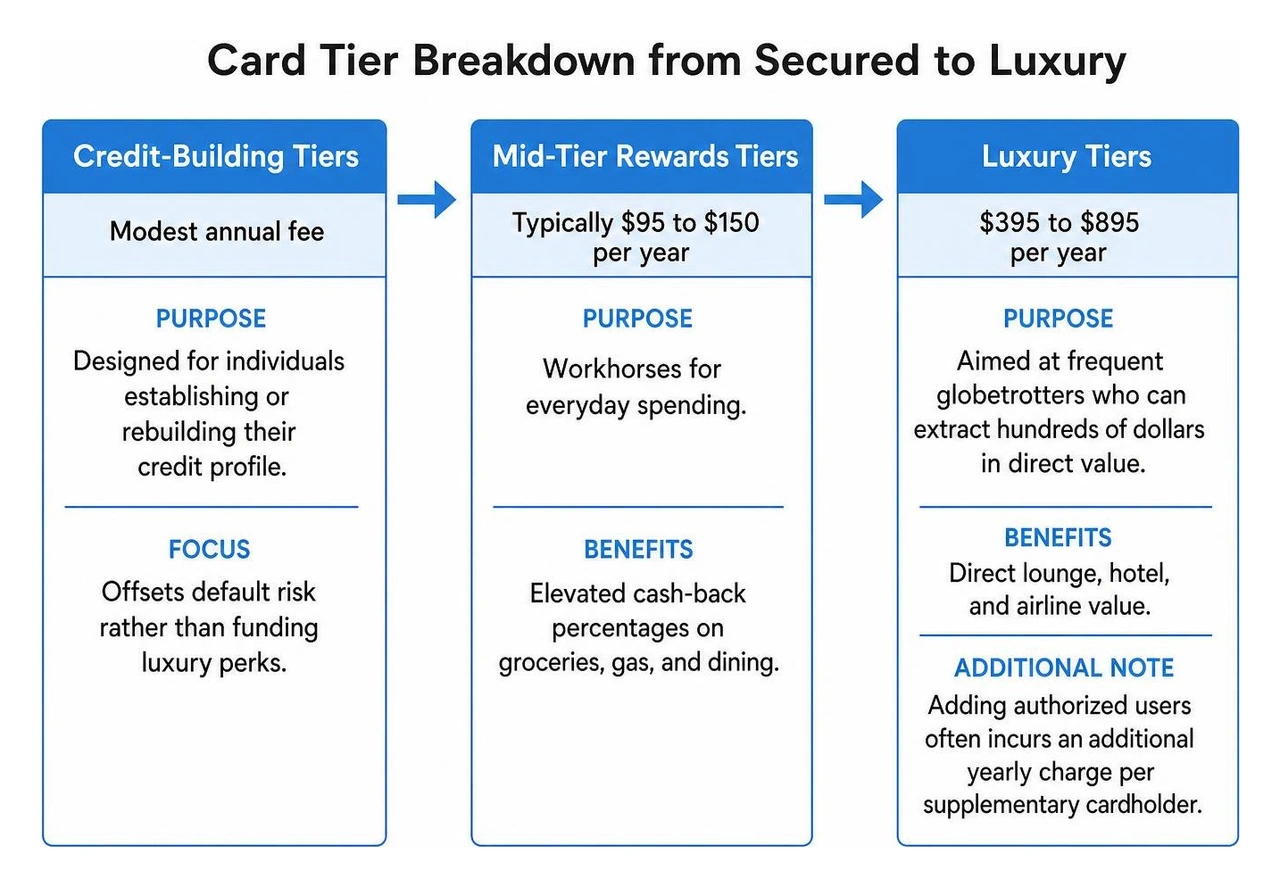
- Credit-Building Tiers: These cards are designed for individuals establishing or rebuilding their credit profile. The modest annual fee offsets default risk rather than funding luxury perks.
- Mid-Tier Rewards Tiers: Ranging typically from $95 to $150, these cards are workhorses for everyday spending, offering elevated cash-back percentages on groceries, gas, and dining.
- Luxury Tiers: Running from $395 to $895 per year, these cards are aimed at frequent globetrotters who can extract hundreds of dollars in direct lounge, hotel, and airline value. Adding authorized users to these accounts often incurs an additional yearly charge per supplementary cardholder.
The Math: How to Decide If an Annual Fee Is Worth Paying
Understanding the theoretical benefits is helpful, but making a sound financial choice requires running the numbers. As outlined in Cardocrat's credit card fee overview, the annual fee is fundamentally the only credit card charge that can actively work in your financial favor—provided the value you reclaim exceeds what you put in.
Calculating the Net Value of Perks vs. Recurring Costs
To establish your break-even point, you must evaluate your actual annual household spending against the card's reward rates and guaranteed credits.
Consider this comparison between a standard no-fee cash-back card earning a flat 1.5% and a $95 annual-fee card earning 2% across all categories:
| Card Type | Annual Spend | Base Reward Rate | Gross Rewards Earned | Annual Fee | Net Financial Value |
|---|---|---|---|---|---|
| No-Fee Card | $10,000 | 1.5% | $150 | $0 | $150 |
| Fee Card ($95) | $10,000 | 2.0% | $200 | $95 | $105 |
| Fee Card ($95) | $25,000 | 2.0% | $500 | $95 | $405 |
| Fee Card ($95) | $40,000 | 2.0% | $800 | $95 | $705 |
At $10,000 of annual spend, the no-fee card leaves you ahead. But as your spending increases past the $19,000 mark, the higher earning rate of the fee card easily pays for its own annual fee and delivers superior net value year after year.
If this calculation produces a positive balance higher than what you could earn on a comparable no-fee card, paying the fee is mathematically justified.
Weighing Recurring Fees Against Long-Term Value
When evaluating recurring costs, automated billing simplifies financial tracking. In our work with fitness facilities, we see how automatic membership payments create a seamless, predictable experience for members.
The same logic applies to cardholders: when you treat an annual fee as an automated operational cost for managing your travel or lifestyle budget, it stops being a surprise and becomes an intentional investment.
However, be mindful of carrying credit balances. Standard credit card APRs currently hover between 20% and 30%. Incurring interest charges on carried balances or paying a 3% to 5% balance transfer fee will quickly erase whatever rewards surplus you worked to build.
Strategies for Managing, Waiving, or Canceling Fee-Bearing Cards
If your card's annual fee is approaching and your spending habits have shifted, you are never locked into paying it indefinitely without options. Cardholders have several actionable paths to consider, as referenced in the Bank of America credit card fees guide.
How to Negotiate Fee Waivers and Retention Offers
Card issuers spend hundreds of dollars in marketing to acquire each cardholder. As your anniversary date approaches, they are often willing to incentivize you to keep your account active:
- Call Customer Support: Dial the number on the back of your card approximately 30 to 45 days before your renewal date.
- State Your Position Clearly: Explain that while you enjoy the card's features, you are reviewing your household budget and finding it difficult to justify the recurring fee.
- Inquire About Retention Offers: Ask if there are retention bonuses, spending incentives, or statement credits available for your account. Issuers frequently offer 10,000 to 30,000 bonus points or a direct statement credit to offset the fee if you meet a modest spending threshold.
- Maintain Consistent Account Standing: Issuers only extend retention offers to accounts in excellent standing. Taking simple steps toward preventing missed payments ensures your profile remains eligible for these valuable retention credits.
Downgrading or Canceling Without Damaging Your Credit Score
If the issuer refuses to offer a retention bonus and the perks no longer fit your lifestyle, consider executing a product change (downgrade) rather than closing the account outright.
- Request a Product Downgrade: Ask the issuer to convert your account to a no-annual-fee card within the same card family. This preserves your original account history, keeps your credit line intact, and eliminates the annual fee without generating a hard credit inquiry.
- Protect Your Credit Utilization: Outright canceling a credit card eliminates that card's credit limit from your total available credit, which can cause your overall credit utilization ratio to spike and lower your credit score.
- Redeem Your Rewards First: If you must cancel, always transfer or redeem your accrued rewards points or cash back before closing the account so you do not forfeit your earned balance.
Frequently Asked Questions About Credit Card Annual Fees
Can a credit card issuer increase the annual fee?
Yes. Credit card companies can change their fee structures. Under federal law, issuers are required to notify cardholders in writing at least 45 days before the change takes effect. If you do not agree to the higher fee, you have the legal right to opt out, pay off your remaining balance under the existing terms, and close the account.
Do all credit cards charge an annual fee?
No. There are hundreds of competitive credit cards available with a $0 annual fee. Many of these cards offer introductory 0% APR periods, solid cash-back rates (typically 1.5% to 2%), and no-cost account maintenance. They are ideal for low spenders, students, or anyone who wants a straightforward payment method without annual overhead.
Are authorized user fees separate from the primary card fee?
Yes, on certain mid-to-high-tier cards. While most no-fee and standard cash-back cards allow you to add authorized users at zero extra cost, premium travel cards often charge an additional $75 to $195 per authorized user. This fee grants the secondary cardholder their own independent lounge access passes, hotel loyalty perks, and insurance protections.
Conclusion
Understanding the true purpose of an annual fee removes the hesitation around fee-bearing credit cards. A recurring fee is neither inherently bad nor an automatic money drain; it is simply a cost-of-service tool. When you leverage bonus categories, travel credits, and retail protections effectively, the net return on a fee card can significantly surpass anything a no-fee alternative can offer.
At Club Systems, we understand how clear, structured recurring dues create predictable value and drive sustainable growth. To discover how membership structures can elevate your business operations, explore how membership fees can boost your business's profits and start making recurring revenue work in your favor today.
Tired of Struggling with Your Gym's Software?
Simplify your operations, save money, and get the support you need with Club Systems.