
When an EFT Wire Transfer Is Worth the Extra Cost


EFT vs. Wire Transfer: When Is the Extra Cost Worth It?
An eft wire transfer is a wire transfer, and a wire is one type of electronic funds transfer (EFT). Compared with an ACH payment, a domestic wire usually arrives faster but costs more and is much harder to reverse. Use a wire for a large, urgent payment. Use ACH for routine gym dues and other payments that can wait.
I’m Eric A. Speer, owner and CEO of Club Systems. My nearly three decades in gym management and billing have taught me to weigh the speed of an eft wire transfer against its cost.

Introduction

Managing cash flow effectively requires balancing speed, certainty, and cost. In 2024 alone, financial networks across the United States processed over 33.6 billion Automated Clearing House (ACH) transfers alongside nearly 210 million wire transfers. While both methods move money electronically without paper checks, they serve fundamentally different operational purposes.
ACH transfers excel at moving large volumes of transactions affordably, whereas wire transfers provide guaranteed, immediate settlement for high-value transactions. Deciding which rail to use comes down to whether your transaction requires instant delivery and guaranteed finality, or if batch-processed affordability is the smarter financial choice.
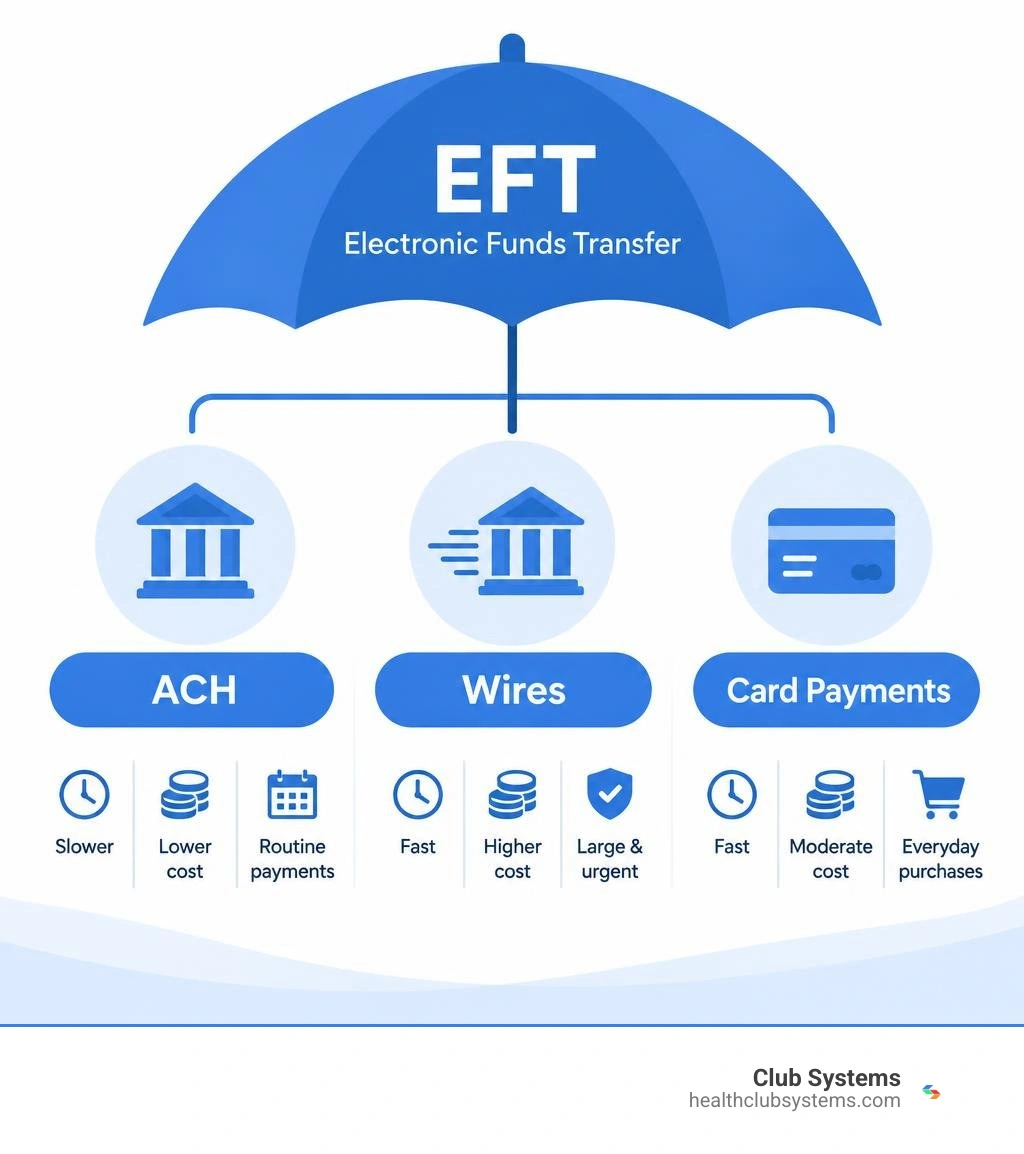
Understanding EFT Wire Transfer Dynamics and Differences
To choose the right payment method, it helps to understand the financial plumbing behind them. Electronic Funds Transfer is not a single transaction type; it is an umbrella term covering any digital movement of money between bank accounts.
When businesses evaluate payment rails, they are primarily comparing batch-cleared ACH networks with Real-Time Gross Settlement (RTGS) wire systems like Fedwire or international networks like SWIFT. The U.S. government details these foundational distinctions in its Treasury guidelines on payment mechanisms and federal fund transfers.
| Feature | Standard EFT (ACH) | Domestic Wire Transfer | International Wire Transfer |
|---|---|---|---|
| Primary Network | Automated Clearing House (Nacha) | Fedwire / Clearing House (CHIPS) | SWIFT Network |
| Settlement Type | Batch processing (Net settlement) | Real-Time Gross Settlement (RTGS) | RTGS via Intermediaries |
| Typical Speed | 1 to 3 business days (Same-Day options) | Instant to same-day (within hours) | 1 to 3+ business days |
| Average Cost | $0.00 to $2.00 (under $0.01 on high-volume agreements) | $15.00 to $35.00 | $35.00 to $50.00+ |
| Transaction Limits | Standard limits; Same-Day ACH capped at $1,000,000 | Frequently $1,000,000+ per day or unlimited | Varies by institution and destination |
| Reversibility | Dispute/reversal windows available | Irrevocable once processed | Irrevocable once processed |
| Best Used For | Recurring member dues, payroll, utility bills | Commercial purchases, escrow, time-critical transfers | Foreign equipment procurement, overseas vendors |
Electronic Funds Transfer as the Broader Payment Category
Because EFT represents the parent category of digital payments, it encompasses a wide range of everyday consumer and business operations. Direct deposits, debit card transactions at point-of-sale terminals, ATM withdrawals, web-based drafts, and peer-to-peer mobile apps all operate under the EFT umbrella.
For service-oriented businesses, understanding how these automated systems work is essential for healthy daily cash flow. You can learn the fundamentals by understanding electric fund transfers for your gym and discovering how automated collection models protect predictable revenue.
The Mechanics of Domestic and International Bank Wires
Wire transfers operate outside the standard batch-clearing process. When a domestic bank wire is initiated, the originating bank sends a real-time payment order to the receiving institution, typically routed directly through the Federal Reserve’s Fedwire Funds Service. Because the Federal Reserve debits the sending bank’s reserve account and credits the receiving bank’s reserve account in real time, funds are cleared individually.
International wires move across borders using the Society for Worldwide Interbank Financial Telecommunication (SWIFT) messaging network. Instead of settling through a single central bank, international transfers often pass through one or more intermediary correspondent banks. Each institution verifies compliance, deducts intermediary service fees, and processes foreign currency exchange margins, which explains why cross-border wires require more time and incur higher processing costs.

Comparing Processing Speeds, Transaction Costs, and Caps
Choosing between payment rails requires balancing your delivery timeline against per-transaction fees and daily account limits.

Understanding these operational boundaries ensures you avoid missed payroll windows or delayed vendor shipments. For a detailed breakdown of how major platforms structure their parameters, review institutional transfer limits and withdrawal caps.
Speed and Cutoff Times: Real-Time Gross Settlement vs. Batch Windows
The standout benefit of a wire transfer is speed. Domestic wires settle continuously throughout the business day, often placing funds in the recipient’s account within minutes of release. However, sending banks enforce strict cutoff windows—commonly 4:00 PM Eastern Time. Submitting a wire after that cutoff pushes execution to the following business morning.
By comparison, standard ACH payments clear in batches across designated daily windows. While Same-Day ACH has expanded clearing capabilities, standard transactions typically take one to three business days to settle, pausing over weekends and New York Stock Exchange holidays.
For regular operations, batch processing remains the most reliable mechanism, which is why automation benefits for recurring membership payments continue to make automated billing the gold standard for monthly subscription management.
Cost Analysis and Institutional Transfer Ceilings
Speed carries a price tag. Financial institutions commonly charge between $15 and $35 for an outgoing domestic wire, with receiving institutions often adding an incoming wire fee of $10 to $20. International wires routinely reach $35 to $50 or more per transaction. Conversely, high-volume ACH transactions cost pennies or even fractions of a cent per batch item.
Capacity thresholds also separate the two systems. Institutional platforms frequently place daily ACH withdrawal caps between $100,000 and $250,000, while Same-Day ACH rules cap individual entries at $1,000,000. FedNow instant credit payments currently support limits up to $500,000.
Bank wires, on the other hand, easily handle transfers of $1,000,000 or more per transaction, making them the preferred vehicle for high-ticket commercial outlays. For routine operational billing, avoiding per-transaction percentage fees is critical, making flat fee billing services for recurring revenue an attractive approach for fitness facilities and health clubs.
Security, Reversibility, and Regulatory Protections
The technical and legal frameworks governing your transfers dictate what happens if an error occurs or fraud takes place.
Federal consumer protections, commercial banking statutes, and authentication safeguards differ significantly depending on whether you send an ACH draft or a bank wire. You can examine these distinctions further in this guide to consumer and commercial safeguards under the Electronic Funds Transfer Act.
Irreversibility and Risk Management in Wire Transactions
A wire transfer is considered final and irrevocable the moment the recipient’s bank accepts the payment order. Because settlement occurs in real time without a centralized intermediary hold, pulling back a completed wire is nearly impossible. If funds are sent to an incorrect account or intercepted via social engineering fraud, recovery depends entirely on the voluntary cooperation of the receiving party.
To guard against catastrophic transfer errors, financial institutions implement strict security protocols governed by Article 4A of the Uniform Commercial Code. Regulators expect strict compliance, as detailed in the NCUA standards on wire transfer security and compliance. Best practices include:
- Enforcing mandatory dual-authorization controls on all wire submissions.
- Requiring out-of-band voice callbacks using pre-established telephone numbers.
- Setting up automated prenote verification before initiating high-dollar transfers.
- Establishing internal transaction limits that require executive sign-off for large outlays.
Error Resolution and Consumer Rights Under Regulation E
Consumer electronic transfers—such as consumer debit card charges and consumer ACH payments—fall under the Electronic Funds Transfer Act (EFTA), implemented by Regulation E. This federal framework provides consumer protections against unauthorized transactions, provided errors are reported promptly:
- Reporting within 2 business days: Limits consumer liability for unauthorized charges to a maximum of $50.
- Reporting between 2 and 60 days: Limits consumer liability to a maximum of $500.
- Reporting after 60 days: The consumer may bear full liability for unauthorized losses incurred past the 60-day statement window.
Financial institutions must initiate an investigation within 10 business days of receiving an error notice and resolve standard disputes within 45 days. However, commercial business accounts are largely exempt from Regulation E consumer dispute protections.
Business owners must rely on their banking contracts and robust internal controls to detect and dispute unauthorized transactions swiftly.
Deciding Between Wire Transfers and Standard EFTs for Business
Running a healthy enterprise requires selecting the right payment tool for each financial task.
Routing every invoice through expensive wire systems erodes operating margins, while using slow batch ACH for urgent commercial transactions can derail major deals.
Why an EFT Wire Transfer Justifies the Premium for Large Acquisitions
Paying a $35 to $50 wire transfer fee makes strategic sense when delay carries severe financial or operational penalties. The premium cost of a wire transfer is justified during:
- Commercial Real Estate and Escrow Closings: Title agencies and escrow officers require immediate, irrevocable cleared funds to record deeds and release property keys.
- Large-Scale Equipment Procurement: Overseas or domestic suppliers often require guaranteed payment before loading freight containers or shipping expensive strength and cardio equipment.
- Time-Critical Vendor Settlements: When avoiding a factory shutdown, preventing an inventory hold, or securing an early-settlement discount depends on same-day funding.
- Emergency Corporate Disbursements: Moving capital rapidly between institutional treasury accounts to meet sudden liquidity or payroll reserve requirements.
Balancing an EFT Wire Transfer with Automated Member Billing
While wire transfers are built for high-dollar, one-off purchases, they are entirely impractical for recurring consumer receivables. Attempting to collect monthly dues via wire transfers would burden customers with unsustainable fees and overwhelm your back-office staff.
For recurring subscription revenue, high-volume automated clearing house debits deliver unmatched efficiency. Processing dues in bulk reduces transaction costs to pennies, eliminates manual invoicing, and provides predictable cash flow.
Gyms and fitness centers protect their cash flow by streamlining recurring EFT dues processing, ensuring hundreds or thousands of membership accounts are collected on schedule without manual intervention.
Frequently Asked Questions About EFT and Wire Transfers
What is the primary difference between an EFT and a wire transfer?
Electronic Funds Transfer (EFT) is a broad category covering all digital money movements, including ACH, debit card transactions, and ATM withdrawals. A wire transfer is a specialized, premium type of EFT that routes individual transactions directly through networks like Fedwire or SWIFT. Wires settle in real time and are virtually irreversible, whereas standard ACH EFTs are batch-processed, take one to three business days, cost significantly less, and allow dispute mechanisms.
Can a completed wire transfer be canceled or reversed?
Generally, no. Once a wire transfer reaches the recipient bank and settles, the transaction is final and irrevocable. A wire can only be canceled if the sending institution intercepts the request before actual transmission through the network. If funds land in an unintended account due to fraud or incorrect routing, recovering the money requires the recipient's voluntary return or formal legal action.
How do domestic and international wire transfer delivery times compare?
Domestic wire transfers submitted before the bank's daily cutoff time (typically 4:00 PM ET) usually settle within a few hours on the same business day. International wire transfers pass through intermediary correspondent banks on the SWIFT network, requiring foreign exchange processing and global compliance checks. As a result, cross-border wires generally take between one and three business days to clear, and occasionally longer depending on destination banking rules.
Conclusion
Understanding when to use an EFT wire transfer versus standard ACH processing keeps your business secure while protecting your bottom line. Reserve wire transfers for high-stakes, time-critical acquisitions, escrow closings, and large vendor orders where immediate settlement finality is essential. For daily receivables, vendor bills, and subscription dues, rely on low-cost automated batch clearing.
At Club Systems, we specialize in providing integrated club management software with reliable dues processing, cash-discount point-of-sale systems, and dedicated, US-based support. Discover how modern payment automation can transform your cash flow by reading what business owners need to know about EFT payments, and optimize your payment workflows today.
Tired of Struggling with Your Gym's Software?
Simplify your operations, save money, and get the support you need with Club Systems.