
EFT Debit Orders and Recurring Mandates Explained Simply


How an EFT debit order works
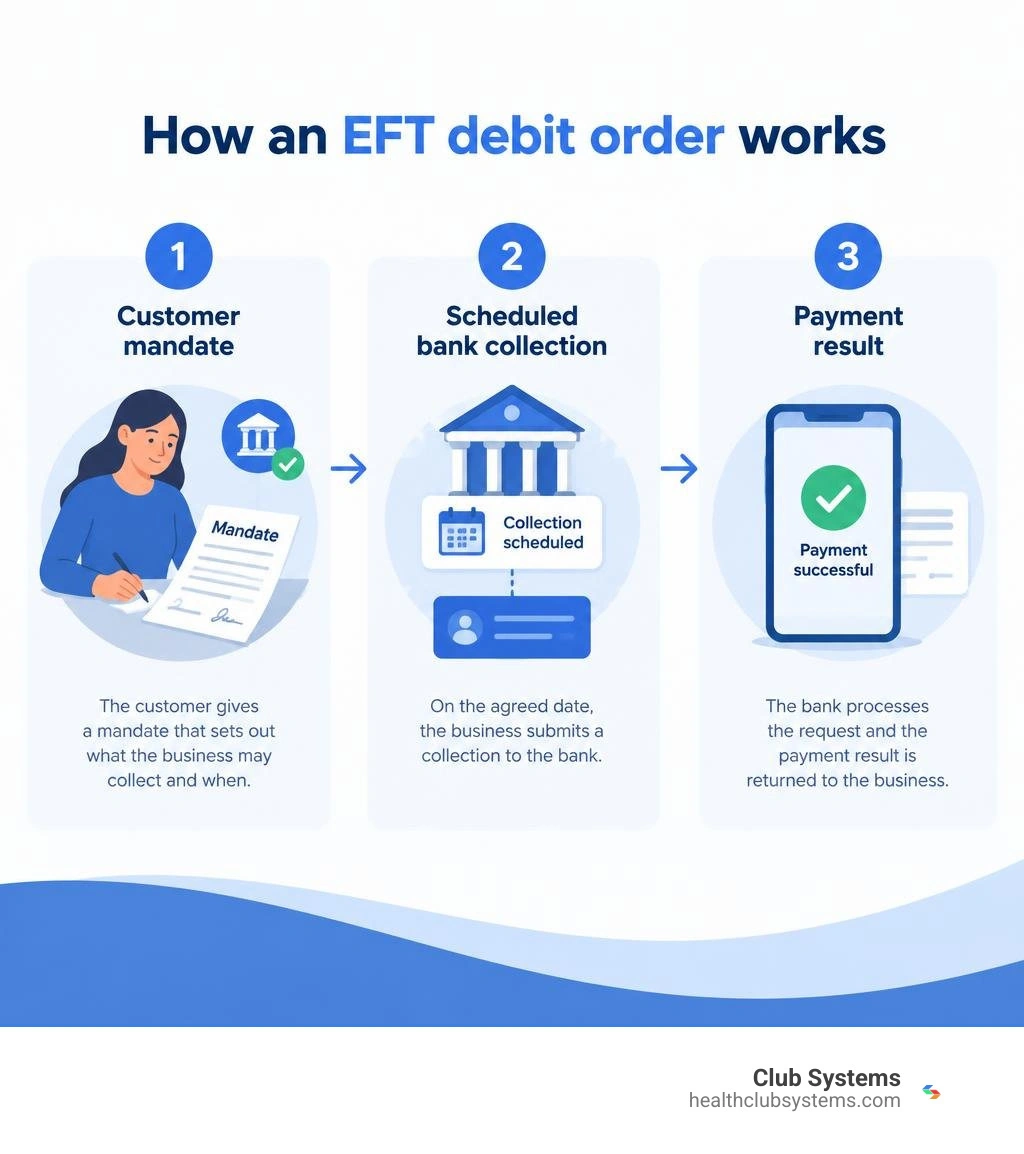
An EFT debit order lets a business collect money from a customer's bank account on an agreed date. The customer first gives a mandate that sets out what the business may collect and when. Unlike DebiCheck, the customer does not confirm that mandate with their bank before collections begin.
For a gym, that can make monthly dues easier to collect. It also means the gym needs clear consent records, accurate billing, and a plan for failed or disputed payments. This guide explains what the mandate covers and what happens after a debit is submitted.
I'm Eric A. Speer, owner and CEO of Club Systems. I've spent nearly three decades working with gym management and dues processing, including the recurring billing needs behind an EFT debit order.
What Is an EFT Debit Order and How Does It Work?
At its core, an electronic funds transfer (EFT) debit order is an instruction given by a business to its bank, pulling funds directly from a debtor’s bank account based on prior authorization. It remains one of the foundational payment streams regulated by clearing houses and central authorities such as the Payments Association of South Africa (PASA).
When a business prepares a collection batch, each record includes critical pieces of data:
- The Action Date: The specific calendar date on which the business intends to debit the customer's account. If this date lands on a weekend or public holiday, rules require the transaction to roll forward to the next business day (the amended action date).
- The Abbreviated Short Name: A merchant identifier (strictly limited to 10 characters) that displays on the consumer’s bank statement so they immediately recognize the charge.
- The Mandate Reference: A unique alphanumeric code tied to the underlying customer agreement.
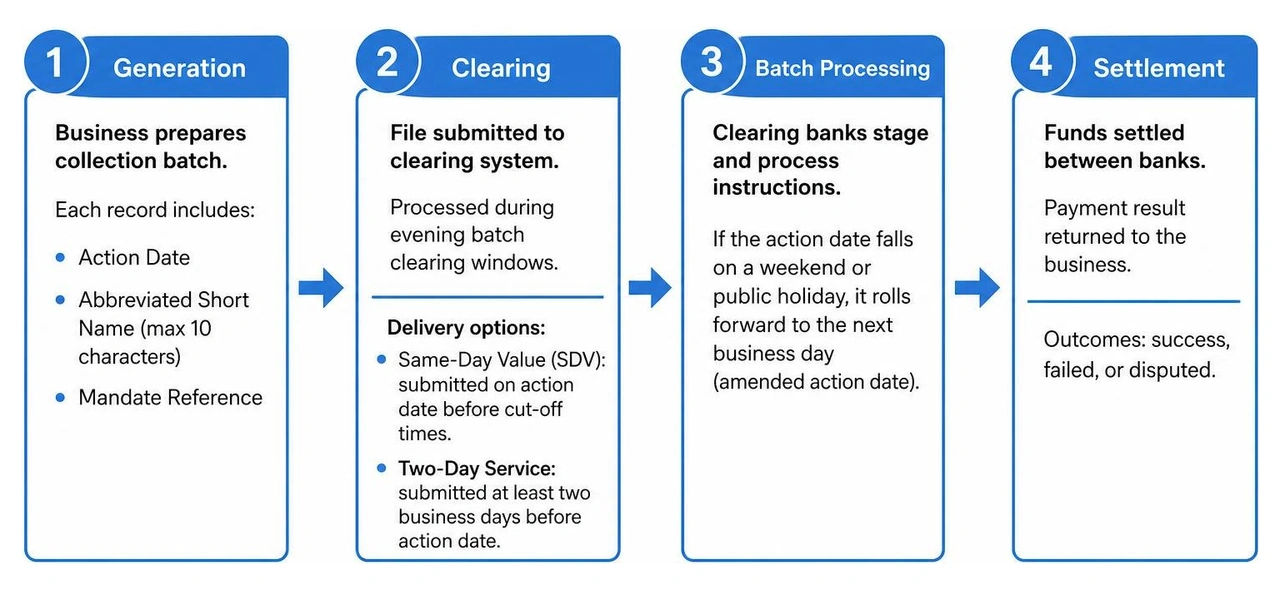
Unlike early morning collections that fire right after midnight to intercept incoming salary deposits, standard EFT debit orders process later in the day during evening batch clearing windows. Businesses submit these files using one of two primary delivery speeds:
- Same-Day Value (SDV): The collection instruction file is delivered to the clearing system on the actual action date before strict daily bank cut-off times.
- Two-Day Service: The billing file is transmitted at least two full business days prior to the desired action date, giving participating clearing banks ample runway to stage the instructions.
Understanding the mechanics of debit order collections in South Africa helps facility owners ensure predictable dues processing without unexpected processing delays.
Comparing an EFT Debit Order to DebiCheck and Registered Mandates
The modern banking landscape utilizes three primary debit collection mechanisms. Knowing the differences ensures you choose the proper rails for your customer base:
| Feature / Criteria | Standard EFT Debit Order | Registered Mandate (RM) | DebiCheck (Authenticated) |
|---|---|---|---|
| Payer Authentication | Non-authenticated (stored by merchant) | Registered in bank system; no digital sign-off | Direct real-time authentication (app, USSD, online banking) |
| Account Type Support | Individuals and Juristic / Corporate (B2B) | Individuals and Juristic / Corporate | Strictly Individual / Consumer accounts |
| Max Transaction Limit | Up to R1,000,000 per instruction | Negotiated per collector agreement | Capped at R30,000 per instruction |
| Processing Window | Evening batch windows (second priority) | Standard daily processing windows | Early morning processing (first priority after salary credits) |
| Credit Tracking | Not available | Limited tracking available | Available (retries across 1 to 10+ consecutive days) |
| Automated Dispute Window | 60 days via banking app or branch | 60 days via banking channels | Generally non-disputable if mandate matches |
Reviewing standard debit order definitions illustrates why many subscription models rely on authenticated channels for high-risk retail billing, while maintaining traditional EFT debit order channels for large enterprise accounts and flexible monthly dues.
Mandate Formats and Regional Compliance Standards
For an EFT debit order to be legally sound, the merchant must capture and maintain a verifiable mandate. Mandates can be secured through three primary channels:
- Written Mandates: Signed physical paperwork containing explicit banking details, debit schedules, and terms.
- Voice-Recorded Consent: Clear, spoken telephonic agreements where all statutory disclosures are acknowledged. These must be archived and transcribed or furnished upon request.
- Digital Electronic Mandates: Web forms, checkouts, and app confirmations where the consumer accepts recurring billing terms via digital signatures and timestamps.
Recent regulatory frameworks established by the South African Reserve Bank (SARB) and regional monetary directives have also reshaped cross-border payment operations. Within the Common Monetary Area (CMA)—comprising South Africa, Namibia, Lesotho, and Eswatini—cross-border low-value retail payments can no longer flow over domestic EFT clearing streams.
To eliminate systemic compliance risks and conform to strict international anti-money laundering (AML) and counter-financing of terrorism (CFT) standards, cross-border payments must originate from in-country domiciled bank accounts or settle via formal regional platforms such as SADC-RTGS or SWIFT. Reading detailed reporting on EFT regulatory changes is essential for any business operating across southern African borders.
The 60-Day Dispute Rule and Payment Reversals
In April 2026, the banking sector implemented a standardized 60-day dispute window across debit payment rails, replacing an outdated framework where dispute cutoffs varied widely between payment types.
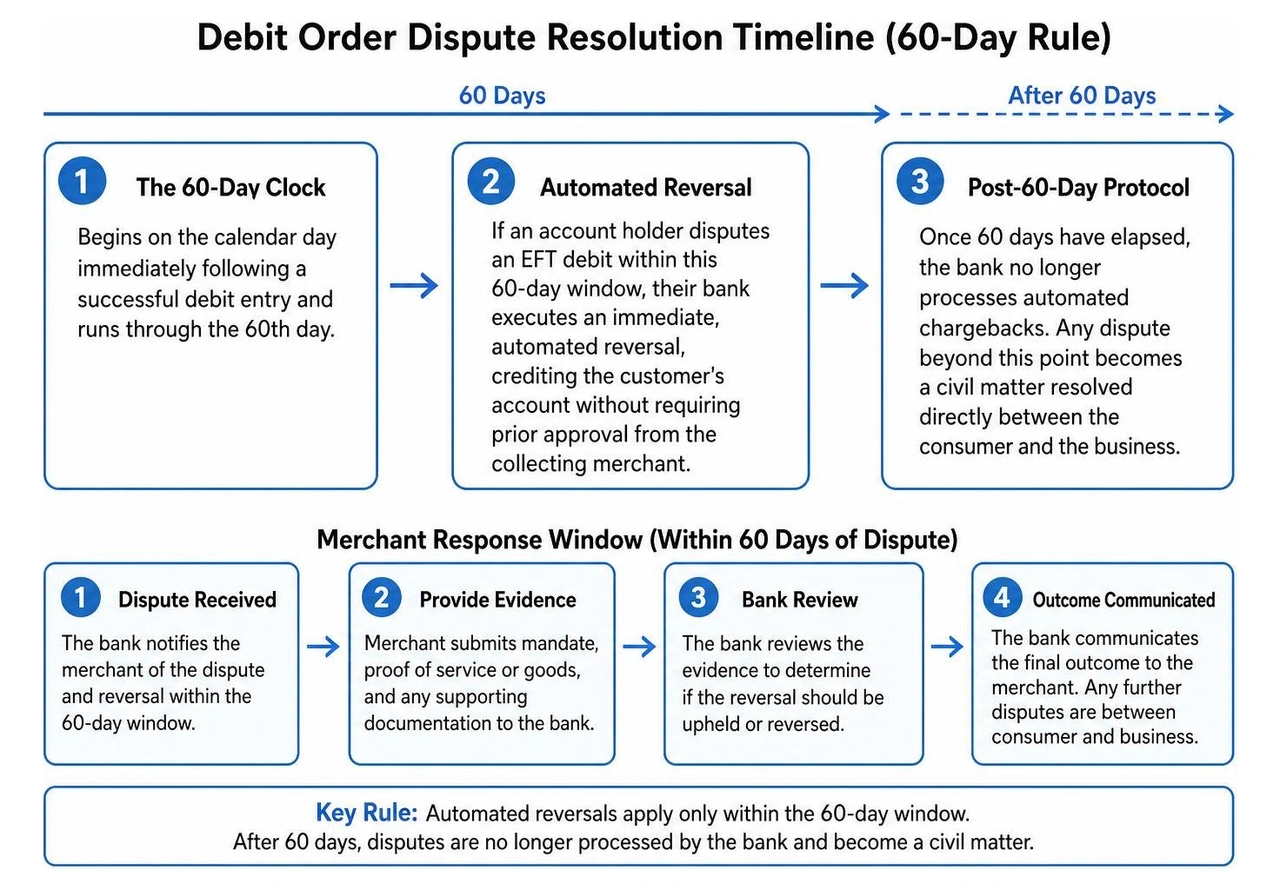
Under this standardized rule:
- The 60-Day Clock: Begins on the calendar day immediately following a successful debit entry and runs through the 60th day.
- Automated Reversal: If an account holder disputes an EFT debit within this 60-day window, their bank executes an immediate, automated reversal, crediting the customer's account without requiring prior approval from the collecting merchant.
- Post-60-Day Protocol: Once 60 days have elapsed, the bank no longer processes automated chargebacks. Any dispute beyond this point becomes a civil matter resolved directly between the consumer and the business.
How to Stop or Dispute an EFT Debit Order Correctly
Consumers can initiate reversals or freeze future deductions directly through mobile banking apps, online portals, or in-branch visits. However, there is a fundamental distinction between stopping a payment instruction and terminating a contract:
- Stop Payment Instruction: A stop instruction lodged with a bank acts as a temporary filter. Crucially, a bank stop-payment instruction typically remains active on banking systems for only three to six months. Once that window expires, a recurring debit submission could successfully hit the account again if not permanently deleted by the merchant.
- Contract Cancellation: Suspending or stopping a bank debit does not cancel the underlying commercial contract. If a customer stops a valid gym membership debit without giving formal contractual notice, the business's accounts receivable ledger continues to accumulate debt.
When consumers abuse dispute mechanisms to reverse legitimate collections, it can trigger adverse credit bureau reporting, collection penalties, and damage their credit rating.
Managing Involuntary Churn and Failed Debits
Failed collections undermine business stability. Involuntary churn—where a customer leaves not out of dissatisfaction, but because of technical payment failures, expired instruments, or transient lack of funds—accounts for 20% to 40% of all subscriber losses in recurring revenue businesses.
EFT processing carries distinct operational constraints:
- 72-Hour Confirmation Window: Unlike instant card payments or real-time authenticated debits, it can take up to 72 hours for banks to return unpaid EFT transaction reports (e.g., "Not Provided For" / Insufficient Funds).
- Return Penalty Fees: Banks penalize account holders with returned debit fees when collections bounce due to insufficient funds, straining customer relations.
- The Two-Consecutive Unpaid Rule: Clearing guidelines dictate that if an EFT debit order is returned unpaid due to insufficient funds on two consecutive action dates, the billing entity is legally required to remove the instruction from the batch submission system. You cannot keep blindly debiting the account without securing a fresh mandate or agreement.
Proactively learning proven strategies for avoiding missed member payments keeps revenue cycles steady and protects member relationships.
Strategic Benefits and Best Use Cases for Recurring Collections
Despite strict dispute rules, EFT debit collections offer substantial strategic advantages, particularly for high-volume billing environments:

- Exceptional Value Caps: While consumer DebiCheck instructions are capped at R30,000, standard EFT instructions support amounts up to R1,000,000, making them indispensable for large commercial leases, wholesale trade accounts, and high-tier equipment financing.
- Support for Juristic Entities: EFT debit orders seamlessly process against commercial and corporate bank accounts that cannot be authenticated via consumer retail channels.
- Low Flat Transaction Costs: Unlike credit card processing, which scales linearly with percentage-based interchange fees, EFT debit fees are generally structured as economical flat fees per instruction.
- Variable Billing Capability: Easily handles dynamic usage charges, pro-rated mid-month joins, and annual facility enhancement fees.
Gyms, health centers, and commercial facilities rely heavily on structured recurring EFT billing to automate monthly collections across large membership rosters.
Maximizing Payment Retention in Subscription Businesses
Modern consumers expect frictionless billing and transparent communications. Industry retention studies highlight why members cancel subscriptions:
- Subscription renewed without clear upfront approval (31%)
- Misinformation regarding recurring amounts or dates (29%)
- Inability to pause or skip billing during life events (27%)
- Inflexible billing frequencies (23%)
- Unavailability of modern digital wallet channels (22%)
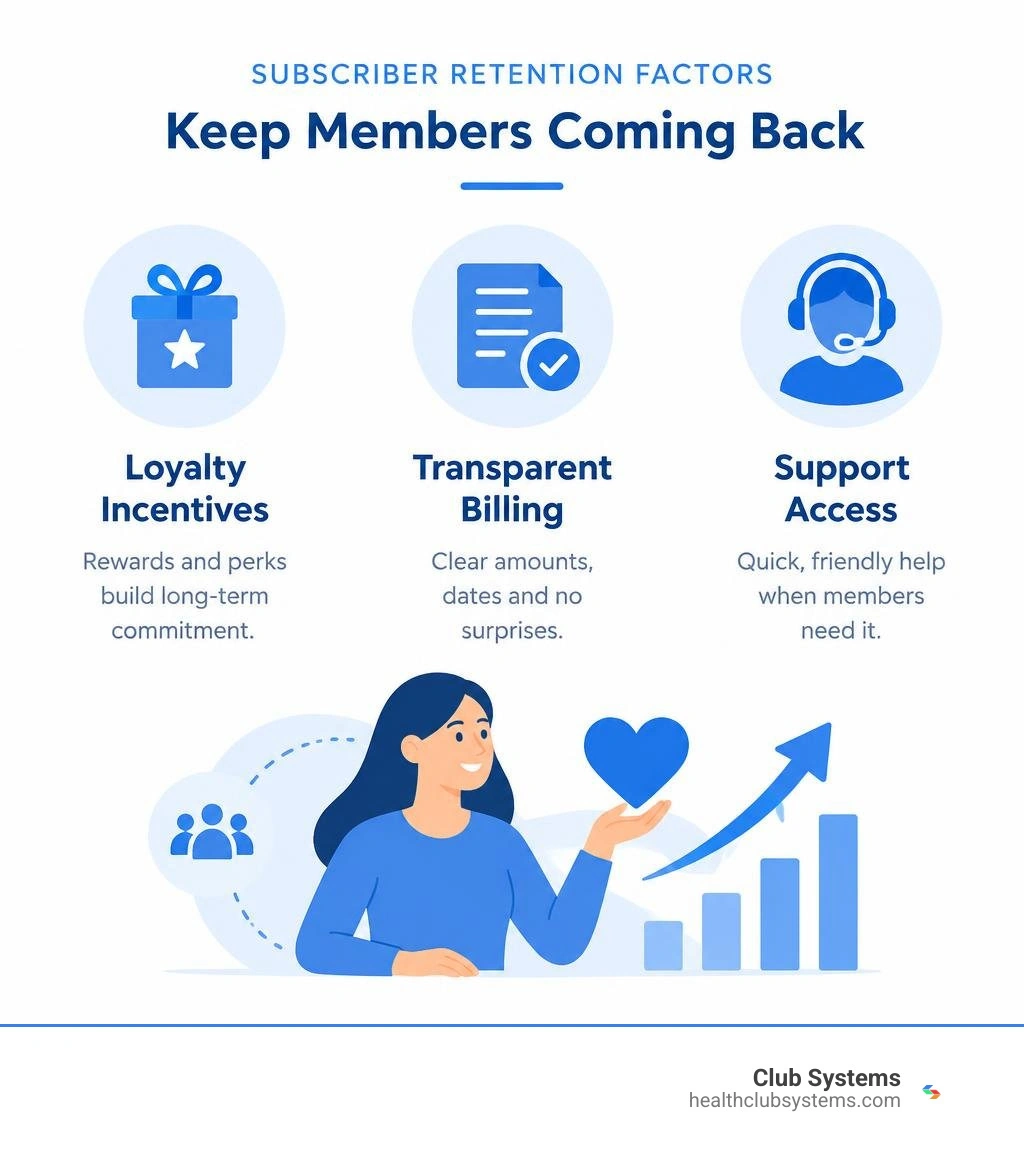
Furthermore, 82% of subscribers report they would remain active if provided loyalty incentives, and 48% feel significantly more valued when recognized with tenure perks. Incorporating responsive service also yields dramatic returns: engaging a customer via live chat makes them 2.8 times more likely to finalize transactions, with 38% completing purchases following a positive real-time support interaction.
Understanding why gyms use automatic membership payments helps facility leaders deploy automated membership systems that drive dependable revenue. Pairing structured billing with dedicated dues processing allows gym operators to offload collection tracking, minimize failed transactions, and maintain direct, human customer support.
Frequently Asked Questions About EFT Debit Orders
What happens if an EFT debit order fails due to insufficient funds?
When an account lacks sufficient cleared balance, the customer's bank rejects the debit with an unpaid code (typically "Not Provided For"). The reporting bank takes up to 72 hours to transmit this failure confirmation back to the billing entity. The customer is charged an unpaid penalty fee by their bank. If a debit fails for lack of funds on two consecutive scheduled action dates, clearing rules mandate that the business remove the instruction from the active batch file until a new agreement is established.
Can a business initiate cross-border EFT debit orders within the CMA?
No. Under current central bank regulatory directives across the Common Monetary Area (South Africa, Namibia, Lesotho, and Eswatini), domestic EFT rails can no longer be used for cross-border debit order collections. A business collecting recurring funds from a customer in another CMA nation must either initiate the debit from a bank account domiciled inside that specific country or process the collection using regional platforms such as SADC-RTGS or SWIFT under heightened AML/CFT reporting rules.
How does the 60-day dispute rule affect merchant chargebacks?
The standardized 60-day dispute window grants bank customers the ability to request an immediate, automated reversal of any EFT debit order within 60 calendar days of the charge date. For merchants, this means that disputed funds are automatically debited from their merchant settlement account without an initial arbitration phase. To mitigate chargeback losses, merchants must maintain verifiable audit trails—including signed physical mandates, digital timestamp logs, or recorded voice approvals—to defend the legality of the underlying contract and recover funds through direct debtor engagement.
Conclusion
Mastering the mechanics of the traditional EFT debit order gives business operators a cost-effective, high-capacity tool for managing recurring cash flow. While the 60-day dispute window and 72-hour failure reporting require rigorous mandate storage and proactive member communication, the high transaction limits and universal account support make EFT debits a core element of any recurring billing toolkit.
By eliminating manual invoicing, organizing digital mandate logs, and deploying automated collection workflows, your facility secures predictable cash flow while providing members with a straightforward payment experience. Discover more about what gym owners need to know about EFT payments and ensure your billing infrastructure is built for long-term retention and reliable revenue growth.
Tired of Struggling with Your Gym's Software?
Simplify your operations, save money, and get the support you need with Club Systems.