
Everything You Need to Know About EFT Debits and Direct Deposits


EFT Debit Meaning: What Gym Owners Need to Know
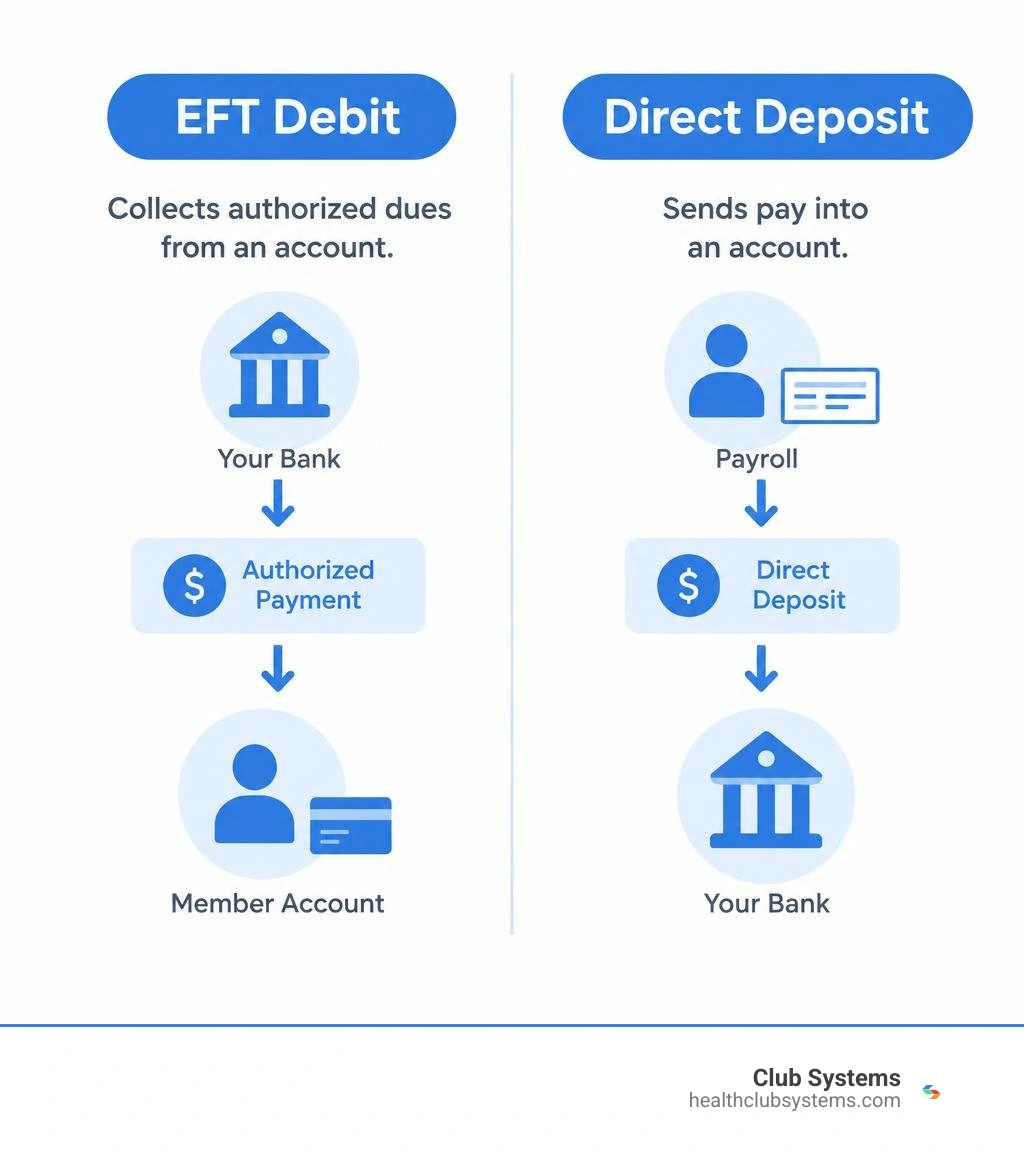
An EFT debit is money taken electronically from a bank account. It may be a one-time payment or an authorized recurring charge, such as a gym member’s monthly dues. A direct deposit works in the other direction: it sends money into an account, as with payroll.
That difference matters when you set up payments and track cash flow. A debit collects money owed to your gym; a direct deposit pays someone else.
I’m Eric A. Speer, owner and CEO of Club Systems. Since joining the company as a programmer in 1995, I’ve helped gym owners understand eft debit meaning and manage recurring member payments.
EFT Debit Meaning: What Is an Electronic Funds Transfer Debit?
To understand how modern banking networks operate, it helps to start with the broader framework. Electronic Funds Transfer (EFT) is an umbrella term covering any transfer of money from one bank account to another that takes place electronically without direct manual intervention by bank tellers or paper checks.
When you explore EFT 101: Understanding the basics of Electronic Funds Transfer, you see that the technology spans everything from ATM withdrawals and point-of-sale card swipes to online bill pay and commercial wire transfers.
An EFT debit specifically refers to an electronic transaction that removes (debits) money from a payer's deposit account. Rather than waiting for a customer to write a check, mail it, and wait for the bank to process it, an EFT debit pulls the approved funds directly through computerized payment networks.
The Core Meaning of an EFT Debit Transaction
At its foundation, the meaning of an EFT debit is a pre-authorized instruction given to a financial institution. The customer grants permission to a business or service provider to withdraw a designated amount of money from their checking or savings balance.
For service-based businesses, establishing automated membership payment workflows eliminates the traditional friction of invoicing. Once authorized, the transaction records electronically on both the payer's and the business’s bank ledger, providing a clean digital paper trail without physical paper handling.
EFT Debit vs Direct Deposit: Push vs Pull Payments
The easiest way to distinguish between different electronic payments is to look at the flow of funds:
- EFT Debit (Pull Payment): The transaction originates from the recipient (the billing business), who "pulls" the funds out of the payer's bank account based on prior authorization. This mechanism powers recurring membership billing, monthly utility payments, and mortgage deductions.
- Direct Deposit (Push Payment): The transaction originates from the payer, who "pushes" funds directly into the recipient's bank account. Common examples include employer payroll distributions, government benefits, and tax refunds.
Understanding this distinction helps facility managers set up their accounts properly. You use direct deposits to pay your personal trainers and staff, while you rely on EFT debits to collect recurring dues from your members.
How EFT Debit Transactions Work: Step-by-Step Processing
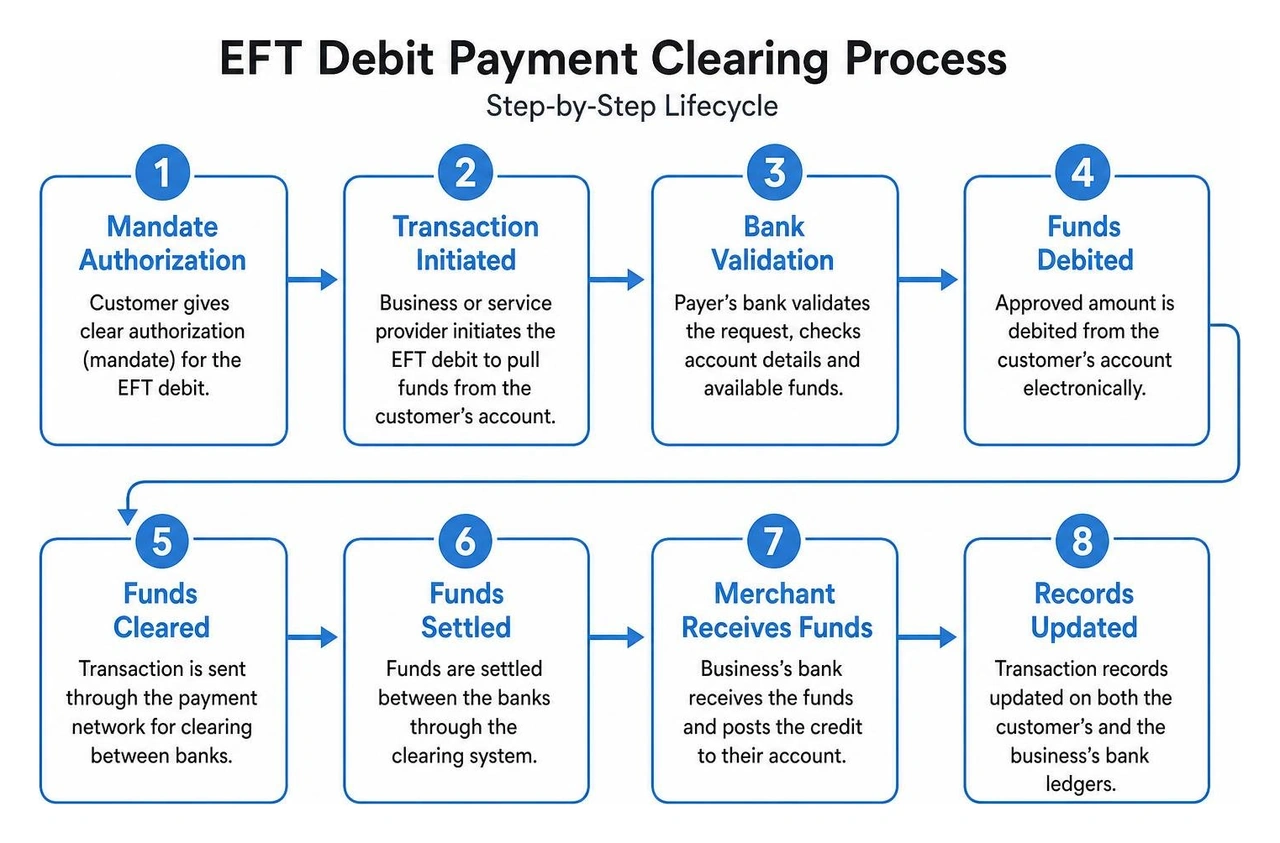
While an electronic debit feels instantaneous to the customer swiping a card or signing a membership agreement, the back-end infrastructure involves multiple regulated steps between financial institutions.
Initiation and Mandate Authorization
An EFT debit cannot legally occur without clear customer authorization, known in banking as a mandate or Pre-Authorized Debit (PAD) agreement. Depending on the payment channel, this consent can be captured via a physical signature, a recorded voice line, or an encrypted digital checkout form.
In international systems, such as the frameworks outlined by the Payment Association of South Africa (PASA) for Debit Orders, mandates are tightly cataloged to prevent unauthorized account access. When managing a high volume of recurring dues, implementing dependable recurring EFT billing solutions ensures these customer consents are stored safely, logged with accurate routing numbers, and matched with specific billing cycles.
Clearing, Settlement, and Processing Timelines
Once an EFT debit batch is generated, it moves through a structured clearing lifecycle:
- Initiation: The merchant’s management software compiles authorized debit requests into a standardized digital file.
- Transmission: The file is submitted to the merchant’s bank (the Originating Depository Financial Institution, or ODFI).
- Clearing: The ODFI transmits the data through a central clearinghouse network, which sorts transactions and routes them to each customer’s individual bank (the Receiving Depository Financial Institution, or RDFI).
- Settlement: The RDFI verifies available funds, debits the member’s balance, and credits the funds to the merchant's account.
Most standard EFT debits clear within 1 to 3 business days, depending on daily cut-off times. Many clearing networks process transactions across several daily batch windows, allowing for same-day settlements when transactions are submitted early in the morning.
Common Types of EFT Debit Payments
EFT debits appear across consumer and commercial banking in several distinct forms, each tailored to specific purchasing environments.
Managing diverse payment streams requires robust gym dues processing systems capable of handling both scheduled recurring debits and spontaneous front-desk purchases.
Debit Card EFT Debit Meaning and Point-of-Sale Transactions
A standard debit card transaction is one of the most familiar forms of an EFT debit. When a customer inserts a chip, swipes, or taps their card at a terminal, the system initiates an electronic fund transfer that verifies available funds and debits their checking account in real time.
As detailed in resources like the First Reliance Bank glossary on Debit Cards, debit cards act as direct digital keys to existing deposit balances.
In markets like Australia, domestic schemes such as eftpos handle point-of-sale volume efficiently. Insights from Adyen Australia on eftpos capabilities show that domestic debit networks frequently utilize Least Cost Routing (LCR). This allows businesses to automatically send contactless debit card payments through the most affordable processing network, bypassing higher credit card scheme fees.
Pre-Authorized Debits, eChecks, and Recurring Dues
For subscription businesses, pre-authorized debits and electronic checks (eChecks) represent the most reliable payment rails. In Canada, businesses frequently rely on Pre-Authorized Debits (PADs) through the Automated Clearing Settlement System (ACSS), as detailed in Venn’s guide to EFT payments for Canadian businesses.
Unlike payment cards, which expire every few years or get canceled due to retail data breaches, bank accounts remain stable for decades. To keep payment pipelines running without disruption, integrating account updater tools helps identify account transitions and maintain consistent billing data, which is essential for avoiding missed member payments.
Comparing EFT Debits, ACH, Wire Transfers, and Credit Cards
Navigating payment terminology can feel overwhelming when different systems overlap. Here is how EFT debits compare to other common transaction types:
| Feature | EFT Debit (Bank-to-Bank / ACH) | Wire Transfer | Credit Card |
|---|---|---|---|
| Primary Rail | ACH / ACSS / Domestic Clearing | Fedwire / SWIFT | Visa / Mastercard / Discover |
| Settlement Speed | 1 to 3 Business Days (Same-day available) | Near Real-Time (Within hours) | 1 to 2 Business Days |
| Typical Cost Structure | Low Flat Fee ($0.20 to $1.50) | High Flat Fee ($15.00 to $35.00+) | Percentage + Flat Fee (1.5% to 3.5%) |
| Payment Finality | Reversible via standardized return codes | Immediate & irrevocable | Subject to dispute / chargeback |
| Ideal Use Case | Recurring dues, subscriptions, B2B bills | High-value, urgent single transfers | Point-of-sale retail, online storefronts |
EFT Debit vs ACH: Network Distinctions
A frequent point of confusion is the relationship between EFT and ACH. Simply put: EFT is the umbrella category, while ACH is a specific network.
All ACH (Automated Clearing House) debits are EFTs, but not all EFTs run through the ACH network. An ATM withdrawal, a wire transfer, and a point-of-sale debit card swipe are all EFT transactions, but they use distinct digital networks rather than the ACH batch-clearing system. ACH is primarily a United States domestic payment system managed by Nacha, designed for cost-effective, high-volume batch transfers.
EFT Debit vs Wire Transfers and Credit Cards
When deciding between payment rails, businesses must weigh speed against cost:
- Wire Transfers: Wire networks like Fedwire move funds individually in real-time. They offer immediate settlement and strict finality, making them ideal for commercial real estate purchases or large equipment acquisitions, but their high fees make them impractical for routine billing.
- Credit Cards: Credit cards provide instant authorization at checkout, but they carry significant merchant processing costs. As outlined in Vitality Cash's comparison of Interac, EFT, and credit cards, credit card interchange fees routinely cost merchants 1.5% to 3.0% per ticket, whereas bank-to-bank EFT debits typically cost a fraction of that in flat fees.
Business Benefits, Fraud Risks, and Regulatory Protections
Non-cash payment volumes have grown by 9.5% annually across modern economies. Major institutions handle enormous volume over these electronic rails—for example, J.P. Morgan processes nearly $10 trillion in global payments daily across 160 countries and 120 currencies.
Transitioning from manual invoicing to automated EFT debits provides substantial advantages for recurring businesses while maintaining a clear framework for consumer security.
Cost Savings, Retention, and Recurring Cash Flow
For gyms and fitness clubs, processing monthly dues via EFT debit provides several operational advantages:
- Reduced Processing Overhead: Replacing percentage-based credit card fees with low, flat-rate EFT debits preserves profit margins on high-volume dues.
- Lower Involuntary Churn: Bank accounts do not expire like credit cards, reducing failed recurring charges caused by expired plastic.
- Predictable Cash Flow: Automated batch submissions ensure member payments arrive on consistent, scheduled calendar dates.
- Streamlined Reconciliation: Integrated billing software automatically marks member ledgers as paid, eliminating manual bookkeeping entries.
- Integrated Recovery: Combining automated billing with proactive collections and recovery ensures returned items (such as non-sufficient funds) are handled systematically without alienating customers.
Regulation E, EFTA Compliance, and Unauthorized Transfer Rules
In the United States, consumer EFT transactions are governed by the Electronic Fund Transfer Act (EFTA), implemented through Regulation E.
The Consumer Financial Protection Bureau outlines specific rules regarding error resolution and customer liability in their Electronic Fund Transfers FAQs. Under Regulation E:
- Consumer Protection: Account holders are protected against unauthorized debits if they notify their bank within 60 days of the transmittal of their bank statement.
- Mandatory Disclosures: Businesses initiating recurring EFT debits must provide clear written terms detailing payment amounts, timing, and cancellation procedures.
- Error Resolution: Depository institutions are legally required to investigate reported errors promptly, often providing provisional credit while discrepancies are reviewed.
Adhering to these standards ensures that businesses operate with transparency while providing customers with confidence in automated billing systems.
Frequently Asked Questions About EFT Debits
Can EFT debit payments be used for international transactions?
Standard domestic EFT debits (such as US ACH or Canadian ACSS) are restricted to their home banking systems. However, international EFTs can be conducted using specialized cross-border payment networks, International ACH Transactions (IAT), or the SWIFT network. Many businesses operating across borders maintain local currency accounts in each country to clear domestic EFT debits without incurring high international wire fees.
How long does an EFT debit payment take to clear?
Standard EFT debits typically settle within 1 to 3 business days. If a transaction is submitted before a bank's daily cut-off window, clearing often occurs on the next business day. Same-day ACH debits are also available through many modern payment gateways, allowing transactions submitted during morning batches to settle by the close of business that same day.
Can an authorized EFT debit payment be cancelled or reversed?
Once an EFT debit file has been processed by the clearing house, it cannot simply be "stopped" mid-transit. However, payments can be returned or reversed after the fact under specific conditions:
- Payer Action: A consumer can request a stop-payment order through their bank prior to scheduled processing, or dispute an unauthorized debit under Regulation E return codes (such as R10 - Customer Advises Unauthorized).
- Merchant Action: If a merchant debits an account in error, they can issue a refund credit or initiate an ACH reversal within established network timeframes (usually within 5 business days of the original transfer).
Conclusion
Understanding how EFT debits work allows business owners to take control of their financial infrastructure. By replacing expensive paper checks and high-fee payment methods with secure, automated bank transfers, businesses can protect their operating margins while delivering a seamless checkout experience for their customers.
At Club Systems, we specialize in providing integrated management software designed specifically for health clubs and fitness facilities. From high-collection-rate dues processing and flat-rate billing tools to automated member management and US-based, real-person support, our platform simplifies your operations.
To dive deeper into setting up an optimized billing structure for your facility, read our full guide on what gym owners need to know about EFT payments and discover how streamlined payment automation can transform your cash flow.
Tired of Struggling with Your Gym's Software?
Simplify your operations, save money, and get the support you need with Club Systems.